
Stage 3 · Object detection
Building the YOLO dataset from MySQL and fine-tuning a fish detector, tracked in MLflow.
Abstract
What this stage produces in one paragraph: a versioned YOLO dataset pulled from MySQL, the fine-tuned detector trained on it, and its registration in the MLflow Model Registry — headline numbers (mAP, dataset size, train/val split) once measured.
Introduction
Section titled “Introduction”Why a dataset needs to be built from MySQL rather than used as flat files
(traceability, reproducibility, the ability to re-run prepare_dataset.py against
a different set of annotation_set_ids without re-touching raw frames). Where
this sits in the pipeline: consumes Stage 2’s annotations table, produces the
detector Stage 4 depends on.
State the two things this stage sets out to do: (1) turn annotated MySQL rows into a YOLO-format dataset folder with a reproducible train/val split, (2) fine-tune YOLOv8 on that dataset and register the result so later stages resolve it by name/alias instead of a hardcoded path.
Methods
Section titled “Methods”Pipeline overview
Section titled “Pipeline overview”Annotated frames leave MySQL as a YOLO dataset folder, a pretrained YOLOv8 is fine-tuned on that folder in a GPU notebook, and the resulting weights are registered in the MLflow Model Registry, so later stages load the detector by name instead of by file path. The figure below shows the full pipeline.
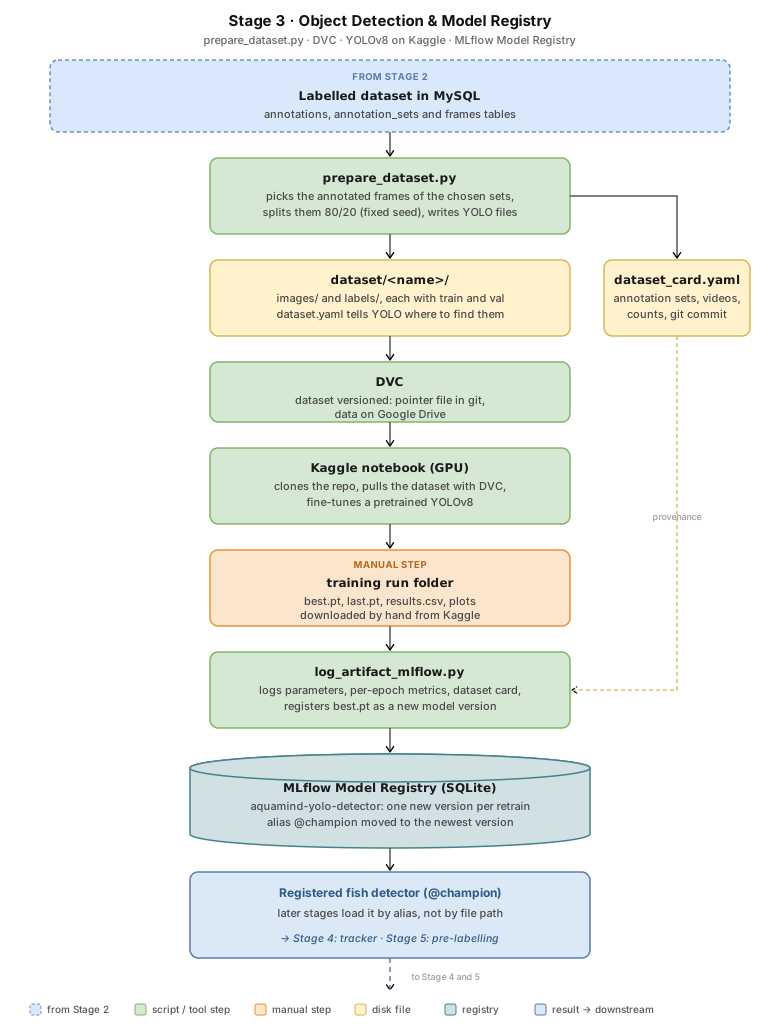
The first three subsections below follow the pipeline from top to bottom.
Dataset construction — prepare_dataset.py
Section titled “Dataset construction — prepare_dataset.py”Query annotated frames from MySQL, 80/20 train/val split, folder layout written
to dataset/{name}/, dataset_card.yaml (counts, annotation_set_ids, git
commit for reproducibility), dataset.yaml for YOLO.
YOLOv8 fine-tuning
Section titled “YOLOv8 fine-tuning”Base model, training config (epochs, image size, augmentation if any), hardware used, what changed between iterations if there were several dataset/training rounds.
MLflow tracking and Model Registry — log_artifact_mlflow.py
Section titled “MLflow tracking and Model Registry — log_artifact_mlflow.py”Logging the run to MLflow, registering best.pt under aquamind-yolo-detector,
moving the @champion alias. Why registry over a hardcoded config.yaml path
(promotion = re-run the script). Two-backend note: SQLite registry vs file-based
mlruns/ for other experiments.
Classes
Section titled “Classes”0 = danio_rerio, 1 = reflection — why reflections are a separate class
rather than filtered out (helps the model learn to ignore them rather than
never seeing them).
(Once trained, this stage’s @champion model is also used in
Stage 5 to pre-label new hard
cases for correction, and the relabelled data comes back here for the next training round.)
Results
Section titled “Results”Dataset construction
Section titled “Dataset construction”Final dataset size (train/val counts), class balance, any frame-source mix (regular, crossing-event and ghosting-event frames, the last two from Stage 5’s relabelling loop).
Detector performance
Section titled “Detector performance”mAP50 / mAP50-95, precision/recall per class, confusion between danio_rerio and
reflection if any, comparison across model versions logged in the registry
(e.g. the v3 champion referenced in later stages).
Discussion
Section titled “Discussion”Honest read of where the detector is strong (clean single-fish frames) and where it struggles (the crossing/merge case that motivates Stage 4’s tracker-side handling and evaluation) — the same “fix is in the labels” thread that Stage 4 concludes with. What would improve mAP further if pursued (more crossing frames via the Stage 5 relabelling loop, more morph diversity).