
Study system
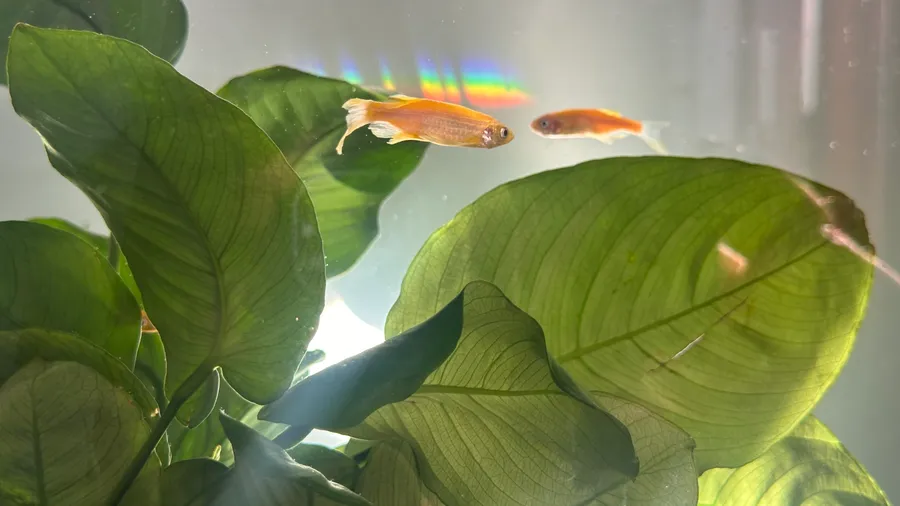
The tank
Section titled “The tank”A 35 × 21 × 23 cm side-view aquarium with an Anubias plant, dark gravel substrate
and PVC-pipe shelters. The fish are Danio rerio, a mix of GloFish and golden
morph, all labelled danio_rerio. The plant and pipes are deliberate: they create
the occlusion that makes identity persistence hard, which is the problem the
tracker and re-identification stages exist to solve.
Recording
Section titled “Recording”A phone camera films the whole tank from the side at 60 fps. Early recordings in HEVC (H.265) produced washed-out frames when decoded by OpenCV, so recording was switched to H.264 (“Most Compatible” mode) for deterministic decoding. See Stage 1.
Videos in use
Section titled “Videos in use”| Video | Contents | Used for |
|---|---|---|
IMG_0350.MOV |
5 fish, 1 plant | Original main tracking video |
IMG_1839.MOV |
5 fish | Re-identification work (Stage 6) |
IMG_2349.MOV |
4 fish | Tracker ground truth (Stage 4), behaviour analysis (Stage 7), feeding experiment (Stage 8) |
IMG_0651.MOV |
5 fish, 1 plant | Labelling reflections |
IMG_0764.MOV, IMG_9856.MOV |
1 live + 1 dead fish | Low-fish-count / no-plant test cases |
Database
Section titled “Database”A MySQL database (aquamind) holds four tables (videos, frames,
annotation_sets and annotations) running in a Docker container. Tracker output
is not stored there. The tracker first wrote tracks to a MySQL tracks table, then
switched to one tracks.parquet file per run, which keeps each run self-contained
next to its crops and config and loads straight into pandas for behaviour analysis.