
Stage 5 · Mining and model-assisted annotation
The detector's own failures choose the frames to relabel, and the detector pre-labels them, so each round trains a better detector.
Abstract
Stage 4 ended on a finding: identity switches at crossings trace back to the detector, so the fix is in the labels. Stage 5 acts on it with a manual improvement loop. The tracker’s own logs are mined for the frames where the detector struggled (two fish overlapping, a fish dropped for a while), those frames are cut from the raw video, the current champion detector pre-labels them inside Label Studio, and the boxes are corrected by hand. The corrected labels go back into MySQL as new annotation sets and the detector is retrained. The model registry holds three distinct versions that mark successive rounds (v1, v3 and v5): validation mAP50 rose from 0.78 to 0.85 and recall from 0.80 to 0.87 as crossing and ghosting frames were added. Those numbers come from validation sets that grew between versions, so they are suggestive rather than a controlled comparison; a fixed held-out comparison is the next step.
Introduction
Section titled “Introduction”Stage 4 concluded that its tracker-side fixes were patches for a detector-side problem: when two fish overlap, the detector merges them into one box, and when a fish is half hidden it can return no box at all, which the tracker sees as a lost fish. A detector trained mostly on regular one-frame-per-second samples has seen few examples of exactly those cases, because they are rare in a random sample.
So instead of labelling more frames at random, this stage labels the frames the current detector gets wrong. They are cheap to find, because the tracker already logs every overlap and every lost-and-recovered fish. The detector helps in a second way: it pre-labels the chosen frames inside Label Studio, so each one arrives already boxed and only needs correcting.
This is a loop and not a single step. It reads the champion model from Stage 3 and a tracker run from Stage 4, it uses the annotation tooling of Stage 2, and it hands a retrained detector back to Stage 3. It sits before re-identification because a detector that drops fewer fish also gives the appearance model cleaner crops. Every step is run by hand. It is a manual, failure-driven form of hard-example mining with model-assisted labelling, and automating it is possible future work, not something claimed here.
Show that targeted, failure-driven relabelling improves the detector, and record exactly which data each model version was trained on, so that every round is reproducible and comparable.
Methods
Section titled “Methods”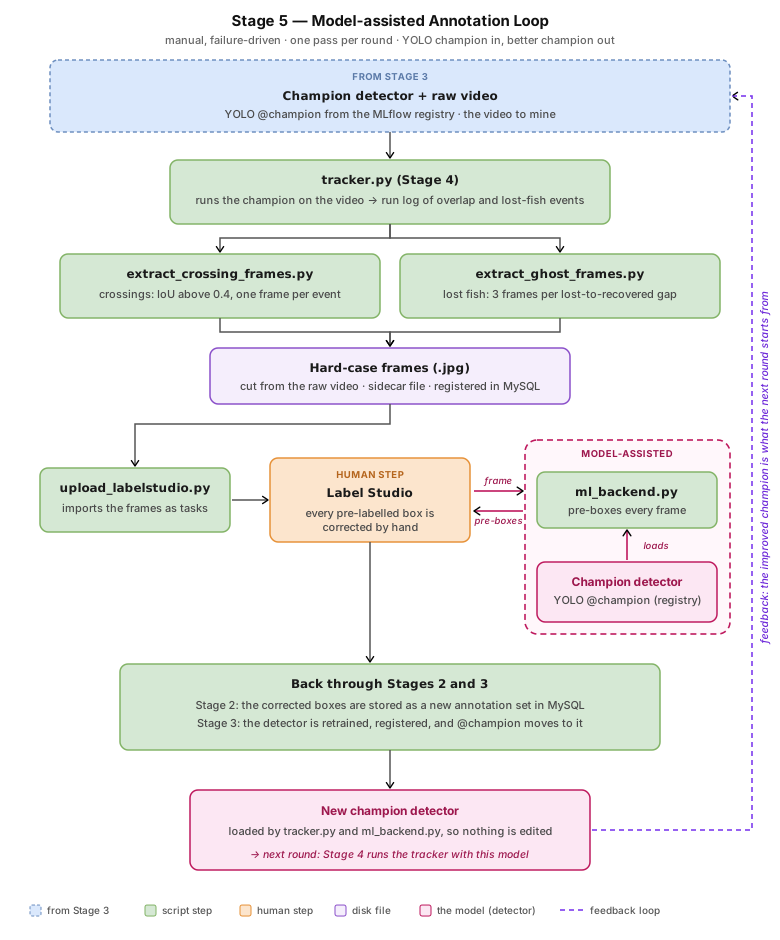
Mining the tracker’s failures
Section titled “Mining the tracker’s failures”A round starts by running tracker.py with the current champion on a video, which
writes a run log of every overlap and every lost-and-recovered fish. Two scripts
then read that log and cut frames from the raw video (never from a tracker
output), so the frames are clean and unannotated.
extract_crossing_frames.pyreads the tracker’s overlap events, each with a frame number and an IoU. It keeps the frames whose IoU is aboveiou_threshold(0.4) and thins them withdedup_window(5 frames) so each crossing event yields one frame and not a run of near-identical ones.extract_ghost_frames.pypairs eachocclusion_lostevent with theocclusion_recoverythat follows it. The frames in between are a gap where a fish had no box. Consecutive gap frames are merged into bursts, andper_burst(3) evenly spaced frames are sampled from each burst.
Some ghost gaps are genuine occlusions, such as a fish behind the plant, and not detector misses. The labelling step is where that gets decided: a frame is only useful if a fish is actually visible in it.
Both scripts write an extraction_params.yaml sidecar recording the frame source
(crossing_event or ghosting_event) and the thresholds used, and register the
frames in the MySQL frames table so the labels can be linked back to them.
Pre-labelling with the current detector
Section titled “Pre-labelling with the current detector”upload_labelstudio.py creates a Label Studio project and imports a frames folder
as tasks. ml_backend.py is a small server that implements Label Studio’s ML
backend API. It loads models:/aquamind-yolo-detector@champion through
model_registry.load_yolo(), the same resolver the tracker uses, and returns YOLO
boxes for the two classes (danio_rerio and reflection). Running Predict All
in the project settings pre-boxes every frame, and each one is then corrected by
hand.
Pre-labelling changes how fast the labelling goes, not which frames are chosen. Its effect on labelling time has not been measured.
Storing the labels, retraining, promoting
Section titled “Storing the labels, retraining, promoting”download_labelstudio.py exports the corrected project in YOLO format, and
store_annotations.py writes it to MySQL as a new row in annotation_sets
(recording the frame source, sampling parameters and Label Studio project, see
Stage 2) plus one annotations row
per box. prepare_dataset.py then builds a training set from a chosen list of
annotation_set_ids, so each model version can be traced to exactly the batches
it saw. The detector is fine-tuned, and log_artifact_mlflow.py logs the run and
its dataset card and registers a new version in the MLflow model registry, moving
the @champion alias to it. Both tracker.py and ml_backend.py load
@champion, so the next round starts from the new model without editing a path.
Results
Section titled “Results”Annotation sets by frame source
Section titled “Annotation sets by frame source”| Annotation set | Frame source | Bounding boxes |
|---|---|---|
| 5 | regular | 445 |
| 8 | crossing_event | 781 |
| 9 | regular | 719 |
| 10 | regular | 224 |
| 11 | crossing_event | 355 |
| 14 | crossing_event | 598 |
| 17 | ghosting_event | 1385 |
Model versions
Section titled “Model versions”| Registry version | Dataset built | Annotation sets used | Train / val images | mAP50 | mAP50-95 | Precision | Recall |
|---|---|---|---|---|---|---|---|
| v1 | 2026-07-20 | 5, 8, 9, 10, 11 | 362 / 91 | 0.784 | 0.401 | 0.802 | 0.797 |
| v3 | 2026-07-21 | v1 + 14 (crossing) | 449 / 113 | 0.806 | 0.431 | 0.859 | 0.792 |
| v5 (champion) | 2026-08-04 | v3 + 17 (ghosting) | 663 / 168 | 0.853 | 0.519 | 0.860 | 0.871 |
The registry also holds v2 and v4, which carry the same dataset and metrics as v1 and v5, so they are left out.
After the first crossing round (v1 to v3) precision rose from 0.80 to 0.86 while recall stayed near 0.79. After the ghosting round (v3 to v5) recall rose from 0.79 to 0.87 while precision held at 0.86, and mAP50-95 rose from 0.43 to 0.52.
Why this is not yet a controlled comparison.
- Each version was validated on its own split, which grew from 91 to 113 to 168 images and contains the harder frames added in that round.
- v1 already contains two crossing sets (8 and 11), so it is not a regular-frames-only baseline.
- These are detector metrics on labelled frames. They do not yet show the thing the loop is for, which is fewer lost fish during tracking.
A controlled version would evaluate v1, v3 and v5 on one fixed held-out set, and run the tracker with each of them on a video that none of them trained on, counting the lost-and-recovered events.
Discussion
Section titled “Discussion”The pattern in the table fits the design. Crossing frames, which show two fish overlapping, coincided with a precision gain, and ghosting frames, which show fish the detector had dropped, coincided with a recall gain. That is the direction a failure-driven loop should move each metric, but with growing validation sets and only three points it is a hint, not a result.
The loop has clear limits. Frame selection depends on the tracker log, so a failure the tracker does not log is invisible to it. Ghost gaps include real occlusions, so they need human review. The data still comes from one tank and a small set of fish, so the gains are for this setup, not for zebrafish in general. And every step is manual, which is why the write-up calls it a loop run by hand.
What would turn this into a solid result is the held-out comparison above, plus a measurement of labelling time per frame with and without pre-labels. The retrained detector then feeds the identity work in Stage 6: fewer lost fish means fewer crossings the appearance model has to audit.